Toho Gas, Toyota Tsusho to produce biogas from sugarcane residue in Brazil
The two companies will work on biogas production from sugarcane residue in Brazil, though output and costs have not been disclosed.

Toho Gas and Toyota Tsusho will produce biogas from sugarcane residue in Brazil. The project combines raw material procurement with production as a business the two companies are undertaking in Brazil. Specific figures such as output, production volume, project costs and the start of operations have not yet been announced.
Sugarcane residue is a byproduct generated in the process of making sugar and ethanol. Typical examples include bagasse, the fibrous pulp left after crushing, and vinasse, the liquid waste remaining after ethanol production, both of which contain large amounts of organic matter. If these materials are fermented rather than discarded, they can be used as energy.
Biogas is a gas produced when microorganisms ferment organic matter such as food waste and livestock manure, and its main component is methane. If the gas generated during fermentation is refined, it can be used as a raw material for city gas or as fuel for power generation. Compared with natural gas derived from fossil fuels, its feature is that the raw material is renewable organic matter.
The fermentation process consists of a series of steps in which anaerobic microorganisms break down organic matter and ultimately produce methane. Temperature control in digesters and pretreatment of the feedstock affect stable production. Sugarcane residue is generally known to be high in fiber, so pretreatment measures are often required.
Possible revenue sources for the business include selling refined biogas, supplying gas and electricity, and selling the digestate remaining after fermentation as fertilizer. Costs consist of collecting and transporting raw materials, capital investment, and operation and management. The profitability of the business will vary greatly depending on which revenue source is placed at the center.
The movement of Japanese gas companies to produce biogas using overseas organic resources is attracting attention as an option for decarbonizing natural gas. Brazil has abundant organic resources from agriculture, and sugarcane residue is said to be stably available from the sugar industry.
Going forward, the key point will be whether the two companies release specific information such as production scale and project schedule. If figures for raw material procurement volume, production capacity and CO2 reduction effects are made public, the overall picture of the project will become clearer.
BLUE NOVA Hydrogen Journal view
The significance of this project is that it expands the raw materials for biogas from domestic food waste and livestock manure to agricultural byproducts overseas. Sugarcane residue is generated continuously in sugar and ethanol production, which could be advantageous for securing raw materials. On the other hand, because figures for production volume and project costs have not yet been disclosed, follow-up reports will be needed to judge the project's viability.
Source: 電気新聞ウェブサイト
This article was written by the editors based on the cited report and translated from Japanese. AI is used to assist in writing and translation.
More news

Hyundai's hydrogen fuel cell car NEXO tops 50,000 units in South Korea
Adoption is growing in South Korea, but subsidy policy and hydrogen refueling network expansion will be the key issues ahead.
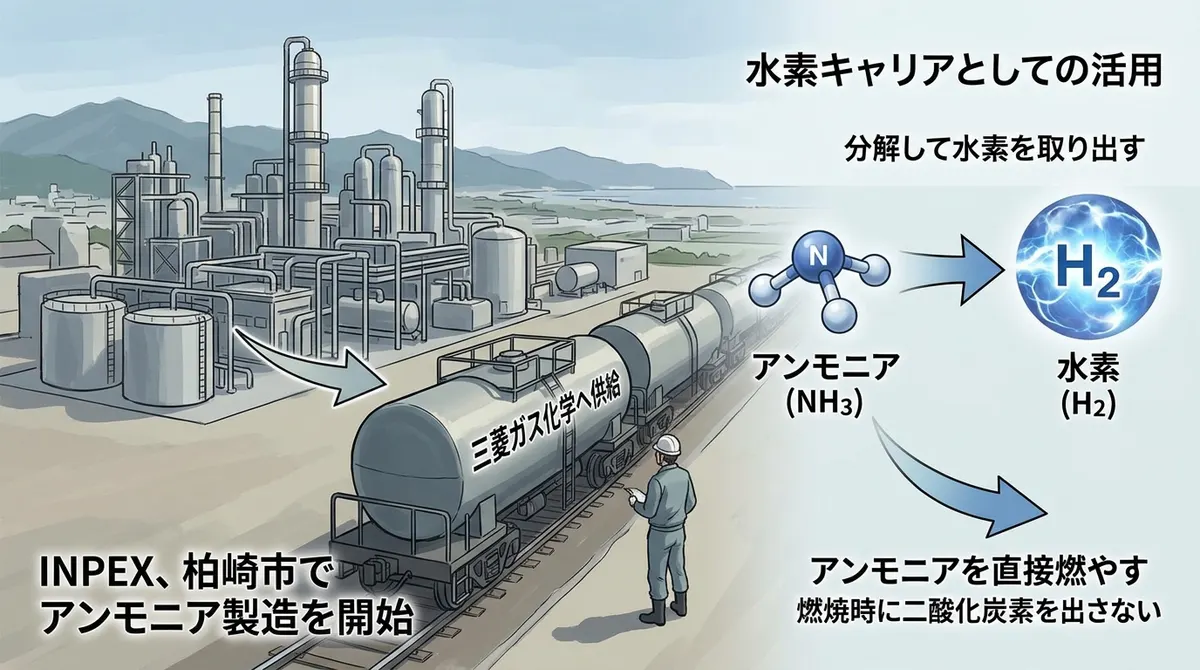
INPEX begins ammonia production in Kashiwazaki, supplies Mitsubishi Gas Chemical
Ammonia made in Kashiwazaki City, Niigata Prefecture, will be supplied to Mitsubishi Gas Chemical, drawing attention as a carrier of hydrogen.

Omron to launch KPTP-B series integrating solar power, battery storage systems and V2H systems
Omron plans to release the KPTP-B series, a lineup that handles solar generation, battery storage and V2H connections as a single system.

Green Carbon Signs MOU With Vietnam Province to Promote Low-Emission Rice Farming
The Japanese firm signed the agreement with the Gia Lai provincial agriculture authority after a 1,000-hectare trial confirmed methane cuts without lower yields.