Sanyo Denki Factory Tests Waste Heat Reuse and Air Volume Cuts in Joint Study
Ryoki Kogyo said its joint study with Shinshu University and Sanyo Denki examined waste heat and unused space at a factory in Ueda through field measurements and analysis.
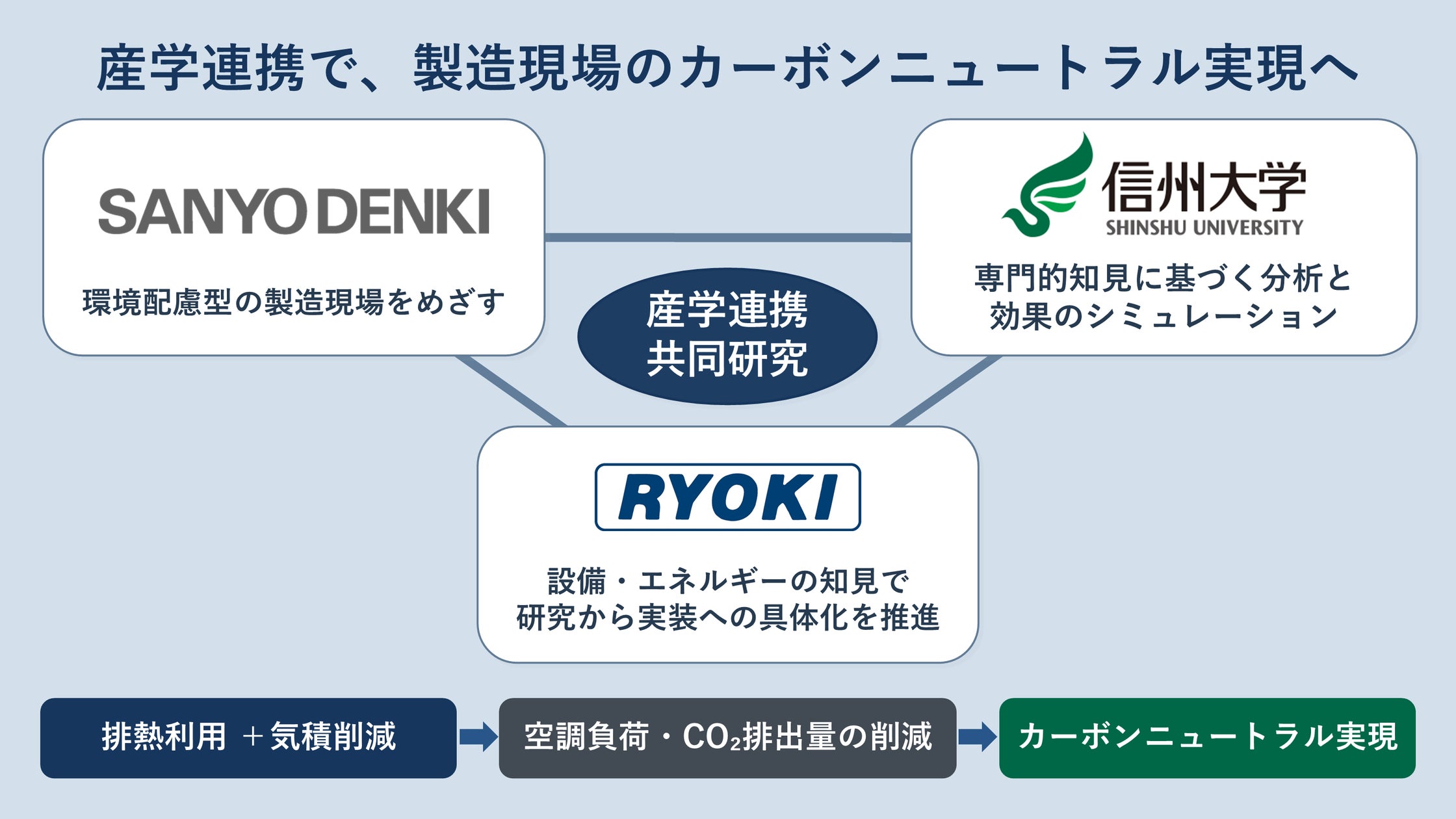
Ryoki Kogyo Co., Ltd. said Oct. 29, 2026, that it had carried out a joint study with Sanyo Denki Co., Ltd. aimed at achieving carbon neutrality at a Sanyo Denki manufacturing plant. The study included the Takamura Laboratory at Shinshu University, and the three parties each contributed their expertise. The target is a manufacturing plant in Ueda, Nagano Prefecture, with a total floor area of 36,500 square meters.
The study comes as Japan seeks to reach carbon neutrality by 2050, making it necessary for manufacturing plants to balance production activities with reducing environmental impact. Carbon neutrality refers to subtracting the amount of greenhouse gases such as CO2 that are absorbed by forests or removed through capture and storage from total emissions, bringing the net total to zero. At manufacturing sites, heat and energy consumed in running equipment can directly translate into emissions.
Rather than relying solely on equipment upgrades, Sanyo Denki chose to view heat and space within existing facilities as valuable resources. The study proposed two measures suited to conditions on site. One is heat reuse, which uses waste heat from thermostatic chambers in an environmental testing room and air inside that room to heat a conference room on the upper floor. The other is air volume reduction, which cuts the unused upper space in a machine manufacturing room.
The verification was carried out through field surveys and measurements at the Ueda plant by Ryoki Kogyo and Shinshu University. Shinshu University analyzed the measurement results and verified the effects through simulation. Heat reuse is a concept that redirects heat that was previously discarded to heating, reducing reliance on other heat sources.
Air volume reduction refers to shrinking the volume of space that must be kept at a set temperature by air conditioning. The energy needed to maintain the same room temperature depends on the size of the space, so the handling of unused upper space could become a target for energy savings.
Going forward, the focus will be on how far the proposed measures are incorporated into factory operations and how the effects will be tracked over time. At manufacturing plants, reviewing existing waste heat and space before making large capital investments can be a practical first step toward decarbonization. The study's distinguishing feature is its combination of on-site measurements and analysis through industry-academia collaboration.
BLUE NOVA Hydrogen Journal view
Decarbonizing a manufacturing plant starts with how to use the heat and space already inside the building before installing new equipment. This joint study focused on two familiar resources, waste heat and unused space, and tested their effects through on-site measurements and simulation. By combining a manufacturer and a university, the approach can address both theory and practice. For companies looking to save energy and cut emissions at factories, the case shows options beyond equipment upgrades.
Source: PR TIMES
This article was written by the editors based on the cited report and translated from Japanese. AI is used to assist in writing and translation.
More news

Asuene to Support CO2 Emissions Calculations for Osaka Marathon 2027 Event
Asuene has signed a sustainability partnership with the Osaka Marathon Foundation to measure CO2 emissions before and after the February 28, 2027, race.

Kose Holdings outlines plan to use green hydrogen to decarbonize cosmetics manufacturing
Kose Holdings said it will use green hydrogen in cosmetics production as part of its drive to cut emissions in manufacturing.

Choshu Industry starts mass production of thin tandem perovskite solar cells
Choshu Industry has begun mass production of tandem perovskite solar cells, a thin, lightweight and bendable next-generation technology.

Florence biogas plant joins gas grid, targeting 6.5 million cubic meters of biomethane
Plures' Casa Sartori plant has been connected to Snam's gas network and aims to produce 6.5 million cubic meters of biomethane by 2026.