Toyota Tsusho selected for METI project to demonstrate sugarcane-based biogas in Brazil
Toyota Tsusho will carry out a demonstration project in Brazil to produce biogas from sugarcane, a project adopted under a program run by Japan's Ministry of Economy, Trade and Industry.
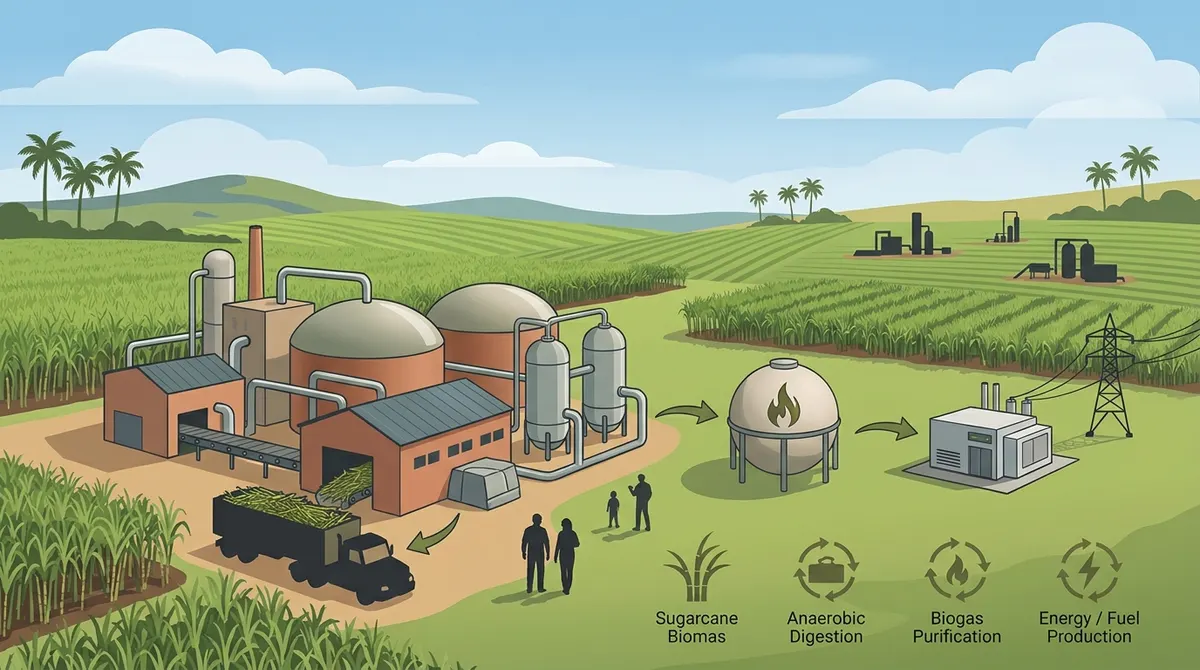
Toyota Tsusho Corporation announced that its plan to demonstrate biogas production from sugarcane in Brazil has been selected for a project run by the Ministry of Economy, Trade and Industry. The demonstration will focus on producing biogas from sugarcane.
Biogas is a methane-based gas produced when organic matter such as food waste and livestock manure is fermented by microorganisms. The technology has long been used at municipal waste treatment plants and livestock farms.
In the fermentation process, organic matter is placed in a sealed digester and broken down over time at a set temperature. The gas released during decomposition is collected, then refined and desulfurized before use.
Sugarcane is grown for sugar and ethanol, and it also produces by-products such as bagasse. Brazil is one of the world's largest sugarcane producers, and efforts to turn its farm resources into energy have drawn interest for some time.
Brazil introduced a national policy in the 1970s to promote ethanol made from sugarcane as a fuel. To reduce its reliance on oil, farm-based fuels have played an important role.
Biogas can be used as heat or electricity. It can also be refined to get closer to the composition of city gas and fed into existing supply networks. The choice of use depends on local demand and equipment conditions.
Being selected for the ministry's program means government support for the technology during its demonstration phase. Demonstration projects typically test issues critical to commercialization, such as collecting feedstock locally, operating stability and product quality.
Bioenergy, including biogas, is increasingly seen as a way to replace emissions from fossil fuels in efforts to decarbonize. However, the emissions reduction effect depends on how feedstock is sourced and how by-products are handled.
The focus going forward will be on the demonstration results and on concrete plans for commercialization. Whether the project can be evaluated as a whole, from securing feedstock to finding buyers for the product, is likely to determine its success.
BLUE NOVA Hydrogen Journal view
Biogas turns waste and farm-based organic matter into energy, and it is positioned as a way to advance decarbonization and resource recycling at the same time. The selection shows that an effort to use sugarcane, a large-scale agricultural resource, overseas is moving into the demonstration stage with national support. Sugarcane-based fuel already has a long record of use in Brazil. If the demonstration confirms feedstock procurement and operating stability, the results could inform decisions to expand similar projects to other regions. BLUE NOVA will be watching how clearly the project's revenue sources and feedstock cost structure become visible after the demonstration.
Source: 日本経済新聞
This article was written by the editors based on the cited report and translated from Japanese. AI is used to assist in writing and translation.
More news

Study uses platinum-based quaternary alloy catalyst to cut green hydrogen costs
Researchers are testing electrolytic reforming of ethanol with a platinum-based quaternary alloy catalyst to lower the cost of producing green hydrogen.

Green Carbon signs MOU with Thai rice firm on low-carbon rice and emission credits
Green Carbon Co., Ltd. has signed a memorandum of understanding with Thai rice processor and exporter Wonnapob Co., Ltd. to combine paddy methane reduction with rice sales.

Tokyu Power Supply links 457 home batteries for first demand-reduction discharge in the TEPCO service area
Tokyu Power Supply remotely controlled 457 household batteries to deliver 787.5 kWh of demand-reduction discharge during a nationwide power supply crunch on October 21, 2026.

Panasonic to mass-produce next-generation perovskite solar cells in fiscal 2029
The company plans full-scale production of the thin, flexible panels for installation on building windows and other surfaces.