Learning from local wisdom: decarbonization as culture and coexistence with Japan's nature
Technology and numerical targets alone fail to close the gap with daily life, so a perspective is presented to rethink decarbonization through local context.

As global boiling advances, decarbonization has been positioned as a shared challenge worldwide. Yet even as technological development advances and countries and companies set numerical targets, a large gap has been pointed out between these efforts and people's everyday lives. From this concern, it has been proposed that attention must be paid to local context, rooted in each region's history and natural environment.
Efforts that rely only on technology or a sense of obligation are said to have limits. Decarbonization pursued as a duty tends to drift away from everyday life and is hard to sustain. Therefore, there is a call to rethink decarbonization through the reverence for nature and the principle of knowing contentment that earlier generations cultivated.
Knowing contentment means choosing a life suited to one's means without seeking more than necessary. Reverence for nature refers to accepting mountains, rivers and the changing seasons as the foundation of daily life. These values have been said to live on in the agriculture, forestry and fishing, housing and festivals passed down in each region.
Japan's climate and terrain differ greatly from region to region, making it difficult to apply the same method everywhere. Energy use and resource circulation differ between life in snowy regions and life on the coast. The view holds that efforts tailored to each area's conditions are what lead to decarbonization that lasts.
The idea of living in a way suited to one's land means that, rather than achieving goals imposed from outside, regions themselves reconsider how they want to live. The approach of using nature's gifts without excess or shortage and circulating resources within the community is more readily accepted when tied to local culture.
This does not reject technological innovation. New technology takes root in daily life only when it is introduced in line with local context. What matters, it has been argued, is not making technology the goal but having local residents judge how it is useful in everyday life.
The question is whether decarbonization can be reframed not only as a target for governments and companies but as part of local culture. Beyond measuring progress toward targets, finding forms that people in each place can sustain with pride is likely to be key to long-term efforts.
Source: IDEAS FOR GOOD
This article was written by the editors based on the cited report and translated from Japanese.
More news

Sustainable Holdings advances business succession of Matsumoto grid-scale battery project toward November 2027 grid connection
Sustainable Holdings said it is moving to advance business succession for the Matsumoto project and file grid connection applications, targeting a Nov. 30, 2027 connection.

MWCC and Rio Tinto to explore microwave-based decarbonization of alumina refining
The companies agreed on Nov. 12, 2026, to design a pilot facility and conduct a feasibility study for microwave-based bauxite processing.

Koh Shibasaki to Produce Three-Day Music Festival in Osaka and Lake Kawaguchi in 2027
The May 2027 festival will be held at Osaka Castle Music Hall and Lake Kawaguchi Stella Theater, expanding from the two-day 2026 event at Lake Kawaguchi.
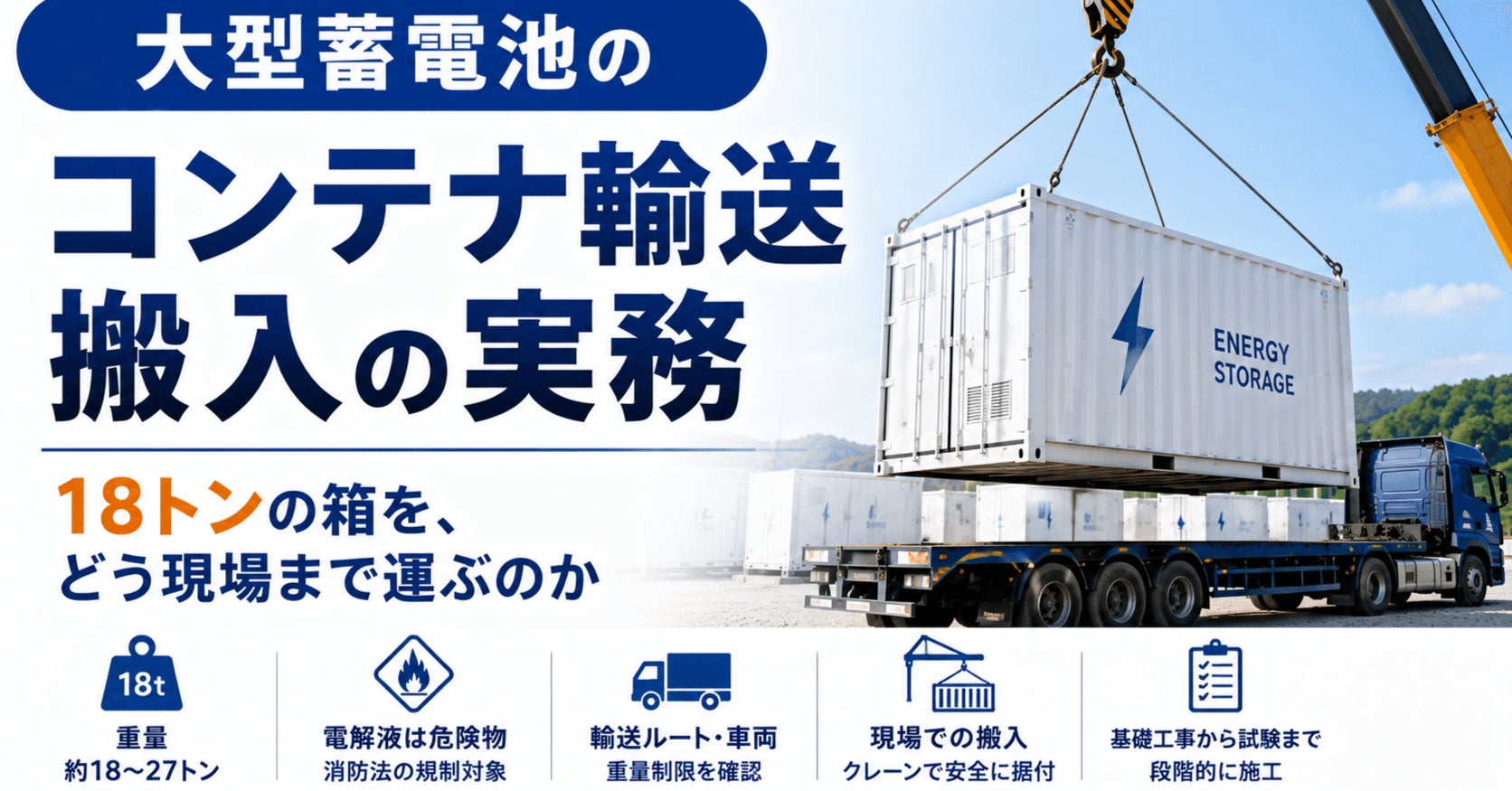
18-Ton Grid Battery Containers Raise Transport and Installation Challenges
The weight of each container and hazardous material rules for battery electrolyte are limiting how grid-scale batteries can be transported.