18-Ton Grid Battery Containers Raise Transport and Installation Challenges
The weight of each container and hazardous material rules for battery electrolyte are limiting how grid-scale batteries can be transported.
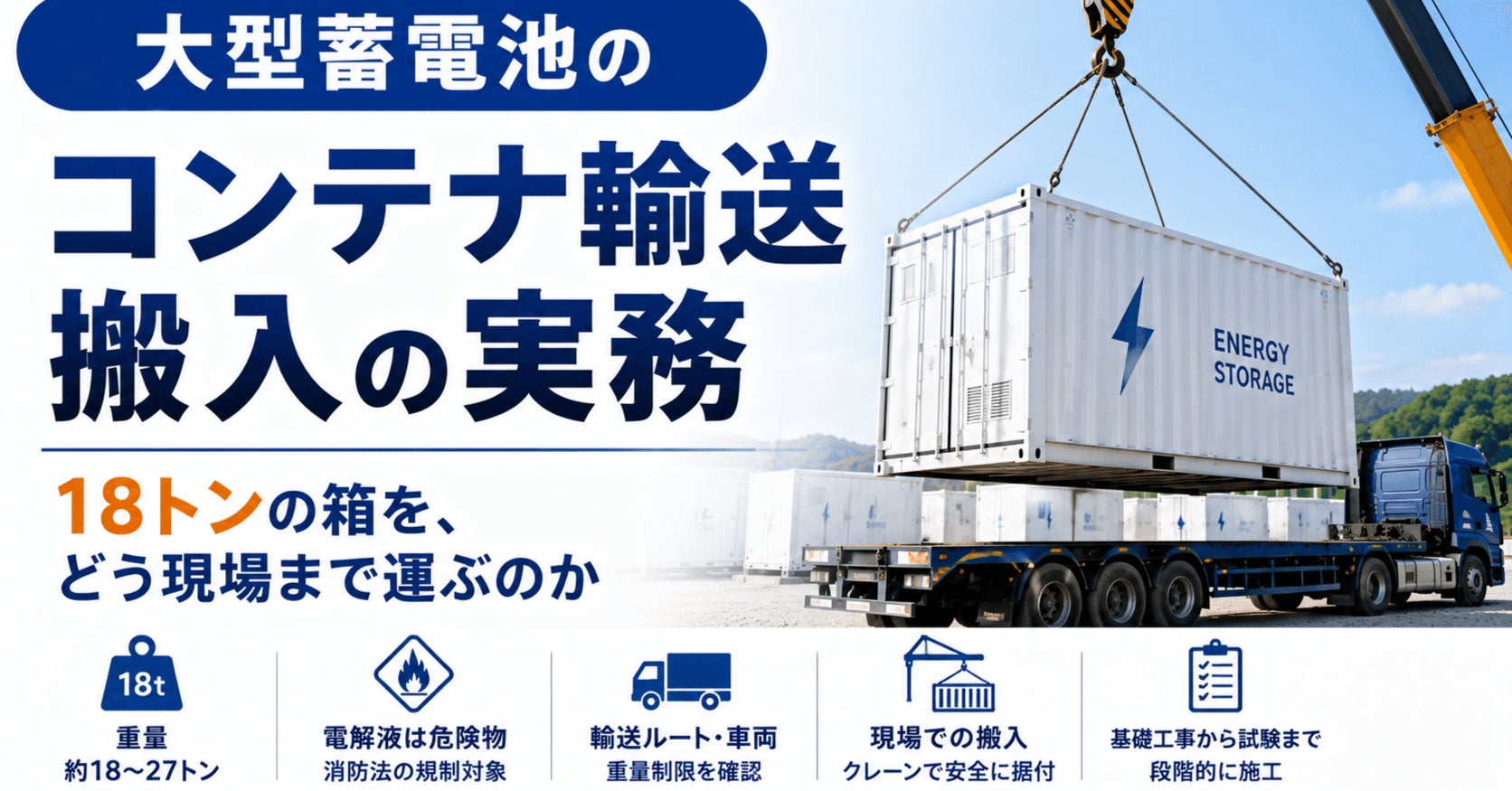
Japan Branding Co., Ltd., based in Inuyama, Aichi Prefecture, announced on Nov. 10, 2026, that it will hold an online webinar in early December 2026 on transporting and installing grid-scale batteries. The company is the exclusive Japanese distributor of batteries made by GUS Technology (格斯科技) of Taiwan. Grid-scale batteries are large batteries connected to the power grid that store electricity and release it as needed.
Grid-scale battery containers are heavy. According to specifications the company cited for a 20-foot container-type storage system from a domestic manufacturer, the weight is about 18,000 kg. A product from another manufacturer weighs about 27,000 kg. Because the weight of several large trucks is concentrated in one unit, transport requires suitable vehicles and route selection that takes into account road weight limits and the load capacity of bridges.
Another constraint is hazardous materials regulation. The electrolyte falls under the category of hazardous materials (flammable liquids) defined by the Fire Service Act. According to a report on a Ministry of the Environment demonstration project cited by the company, efficient and safe transport is one of the challenges in reusing used lithium-ion batteries. The report points out a trade-off: reducing transport volumes to improve safety increases transport costs and CO2 emissions.
This constraint also applies to new cells. Companies must keep hazardous materials controls in place throughout the entire process, from overseas factories to domestic construction sites. Because transport planning affects the schedule of the overall installation plan, it is an important practical issue for operators.
On site, equipment is generally installed after foundation work is complete. Arranging heavy machinery to lift the containers and confirming the width and strength of access roads are also essential. The company said the webinar will address these practical aspects of transport and installation.
Grid-scale batteries are spreading with the growing adoption of renewable energy sources, such as solar and wind power, whose output fluctuates. They are expected to play a role in balancing electricity supply and demand, but challenges in transporting the equipment must be factored into business plans from the early stages.
Battery storage facilities generally follow a business model in which they charge and discharge depending on supply and demand conditions and earn revenue in return. Transport and installation costs form part of the initial investment and operating costs of such projects.
The webinar is positioned as a forum for operators considering adoption to learn about the practical aspects of transport and installation. Whether large storage equipment can be delivered to sites as planned is one factor that will affect the future expansion of adoption.
Background
Grid-scale batteries are large batteries connected to the power grid that store electricity and release it during periods of high demand. As output from renewable energy sources varies with the weather, adoption is spreading as a means of balancing supply and demand. Containerized products are assembled at factories, then transported to sites and installed. The electrolyte is flammable and is treated as a hazardous material under the Fire Service Act, so careful transport management is required.
Source: PR TIMES
This article was written by the editors based on the cited report and translated from Japanese.
More news
Sustainable Holdings advances business succession of Matsumoto grid-scale battery project toward November 2027 grid connection
Sustainable Holdings said it is moving to advance business succession for the Matsumoto project and file grid connection applications, targeting a Nov. 30, 2027 connection.

Learning from local wisdom: decarbonization as culture and coexistence with Japan's nature
Technology and numerical targets alone fail to close the gap with daily life, so a perspective is presented to rethink decarbonization through local context.

MWCC and Rio Tinto to explore microwave-based decarbonization of alumina refining
The companies agreed on Nov. 12, 2026, to design a pilot facility and conduct a feasibility study for microwave-based bauxite processing.

Koh Shibasaki to Produce Three-Day Music Festival in Osaka and Lake Kawaguchi in 2027
The May 2027 festival will be held at Osaka Castle Music Hall and Lake Kawaguchi Stella Theater, expanding from the two-day 2026 event at Lake Kawaguchi.