Inner Mongolia 600-MW Project to Become World's Largest Green Hydrogen Facility
A 600-megawatt project under way in China's Inner Mongolia Autonomous Region is expected to become the world's largest green hydrogen facility when completed.
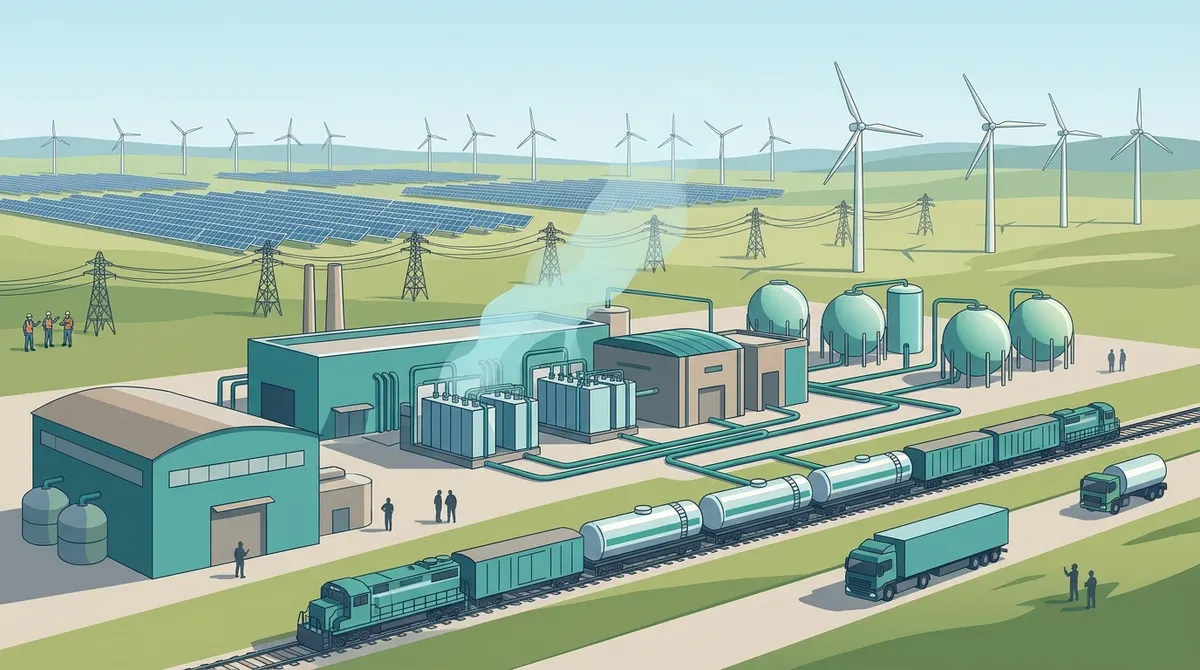
Green hydrogen is hydrogen produced by splitting water through electrolysis using electricity from renewable sources such as solar and wind power. Because electricity is passed through electrolyzers to separate water into hydrogen and oxygen, no CO2 is emitted during production. It is considered to offer a greater decarbonization effect than gray hydrogen, which is made from natural gas.
A capacity of 600 MW represents a large-scale output. Because wind and solar power generation fluctuates with the weather, electrolyzers must be operated in line with variable electricity supply. The technical challenge lies in how efficiently hydrogen can be produced continuously under conditions where power supply is unstable.
The hydrogen produced is being considered for use as a raw material in the chemical industry, as a reducing agent in steelmaking, and as fuel for fuel cell vehicles and power generation. By establishing transport and storage methods, hydrogen can also serve as a means of delivering renewable energy to distant demand centers. Building a system that links production and use will be important.
The profitability of the project will depend heavily on the cost of procuring electricity and the selling price of hydrogen. Whether renewable electricity can be secured at low cost is the single largest factor determining production costs. Securing buyers for the hydrogen produced is also directly tied to the project's long-term viability.
Attention will focus on construction progress and the timing of the start of operations. Whether the large-scale facility can actually produce the planned volume of hydrogen will be a key factor in its evaluation. The project's results need to be assessed by comparison with the trends of similar large-scale projects.
Source: Green Building Africa
This article was written by the editors based on the cited report and translated from Japanese.
More news
Sustainable Holdings advances business succession of Matsumoto grid-scale battery project toward November 2027 grid connection
Sustainable Holdings said it is moving to advance business succession for the Matsumoto project and file grid connection applications, targeting a Nov. 30, 2027 connection.

Learning from local wisdom: decarbonization as culture and coexistence with Japan's nature
Technology and numerical targets alone fail to close the gap with daily life, so a perspective is presented to rethink decarbonization through local context.

MWCC and Rio Tinto to explore microwave-based decarbonization of alumina refining
The companies agreed on Nov. 12, 2026, to design a pilot facility and conduct a feasibility study for microwave-based bauxite processing.

Koh Shibasaki to Produce Three-Day Music Festival in Osaka and Lake Kawaguchi in 2027
The May 2027 festival will be held at Osaka Castle Music Hall and Lake Kawaguchi Stella Theater, expanding from the two-day 2026 event at Lake Kawaguchi.