Ricoh to Expand Production Capacity at New Atsugi Building Including Perovskite Parts
Ricoh plans to build a new facility in Atsugi, targeting completion in fiscal 2028, and include perovskite-related components in its production scope.
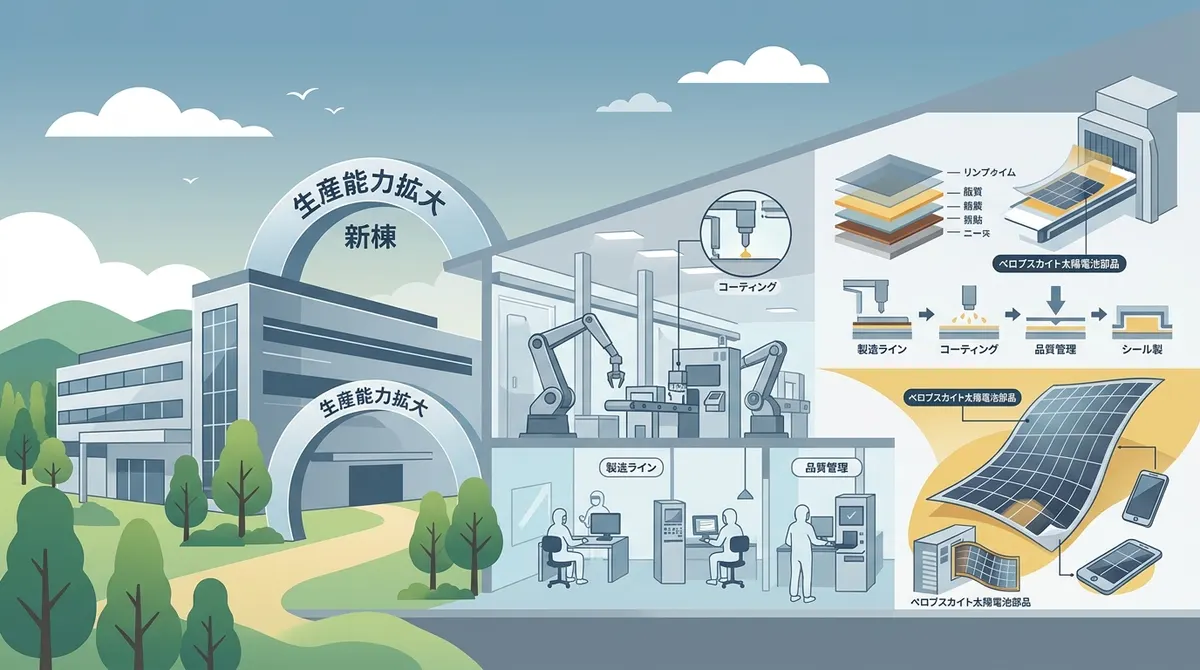
Ricoh Co. will build a new building in Atsugi, Kanagawa Prefecture, targeting completion in fiscal 2028. The company plans to expand production capacity and also include perovskite-related components in its production scope.
Construction of the new building is aimed at easing production capacity constraints at existing facilities. Securing new production lines would make it easier to set up a supply system that responds to changes in product demand.
Perovskite-related components refer to materials used in manufacturing thin, lightweight solar cells. Because precise quality control is required in processes such as material coating and sealing, companies with manufacturing technology are drawing attention as potential entrants.
The current plan does not disclose specific figures, such as the types of components to be produced in the new building, investment amounts or production volumes. The completion target of fiscal 2028 is the main information that can be confirmed at this point.
Key points to watch going forward are the progress of capital investment toward operation of the new building and the specific supply destinations for perovskite-related components. The focus will be on how the Atsugi building fits into Japan's solar power supply chain.
BLUE NOVA Hydrogen Journal view
Expanding perovskite solar cell adoption requires building a supply network that includes components and manufacturing equipment, not just power-generating layer materials. Ricoh's move to expand capacity at its Atsugi building and extend it to related components can be read as a step toward broadening the manufacturing base. However, completion is targeted for fiscal 2028, so actual operation and the ramp-up of production remain items to be confirmed. Readers should track which components will be supplied, and in what volumes, after the new building is completed.
Source: カナロコ
This article was written by the editors based on the cited report and translated from Japanese. AI is used to assist in writing and translation.
More news

PowerX, Kansai Transmission & Distribution Co., Inc. agree on battery-based grid connection
PowerX and Kansai Transmission and Distribution signed a basic agreement on a new grid connection and facility development method using storage batteries, the companies announced on October 30, 2026.

Used PCs to Be Recycled into Medals for the Osaka Marathon 2027
Linet Japan Group and its partners have announced a plan to collect unwanted household computers and turn them into gold, silver and bronze medals for the Osaka Marathon 2027.

Obayashi and others develop system making hydrogen on building rooftops for power generation
Obayashi Corporation and its partners unveiled a system that produces hydrogen on a building's roof, stores it in hydrogen-absorbing alloys and uses it to generate electricity.
Asuene to Support CO2 Emissions Calculations for Osaka Marathon 2027 Event
Asuene has signed a sustainability partnership with the Osaka Marathon Foundation to measure CO2 emissions before and after the February 28, 2027, race.