Chinese firm plans perovskite pilot line aimed at automotive and space markets
Chinese company Riyao Guangdian has announced plans for a perovskite material pilot line, targeting the automotive and space markets.

Chinese company Riyao Guangdian has revealed plans to set up a pilot line for perovskite materials. The company plans to target the automotive and space sectors as its main markets.
Perovskite is a general term for materials with an ABX3-type crystal structure, and it is used in the light-absorbing layer of solar cells. Compared with silicon-based solar cells, it can be made thinner and lighter, and it is easier to apply to curved surfaces and flexible substrates.
In the automotive sector, the material could be used as a thin power-generating film attached to curved car bodies and windows. In space, weight directly affects launch costs, so demand for lightweight, thin solar cells is said to be high.
A pilot line is a facility that manufactures materials achieved at the laboratory level under conditions close to mass production. At this stage, the main goals are to verify manufacturing yield and durability against heat and humidity.
Perovskite solar cells are being researched and developed as next-generation solar technology in both China and Japan. Mass-production techniques and long-term durability are seen as keys to widespread adoption, and companies in several countries are competing to move toward mass production.
Key points to watch include whether the transition from pilot production to mass production proceeds as planned, and whether the material can meet the durability required for automotive and space uses. If the scale and timing of the pilot line are disclosed, its impact on the market can be assessed more concretely.
BLUE NOVA Hydrogen Journal view
Perovskite solar cells could open uses different from existing silicon-based cells by taking advantage of their lightness and thinness. The move to target automotive and space fields, where weight and shape constraints are strict, clearly shows the characteristics of this material. Setting up a pilot line marks a milestone in moving from research to commercialization. Whether mass-production technology and durability testing progress will be the focus for judging its practicality in the renewable energy field.
Source: 36Kr Japan
This article was written by the editors based on the cited report and translated from Japanese. AI is used to assist in writing and translation.
More news
RIKEN VITAMIN and Puchipuchi co-develop masterbatch made from recycled raw materials
The masterbatch, which uses recycled raw materials, has been used in some Puchipuchi bubble cushioning products since April 2026.

Yamaguchi seminar on logistics efficiency and decarbonization set for Nov. 18 in Shimonoseki
The seminar, following full enforcement of the revised Logistics Efficiency Act, covers modal shift and joint transport.
Socotec gives reasonable assurance for CFP of Asahi Kasei's Korean unit's acrylonitrile
Socotec has provided reasonable-level assurance for the fiscal 2025 product CFP of acrylonitrile made by Tongsuh Petrochemical.
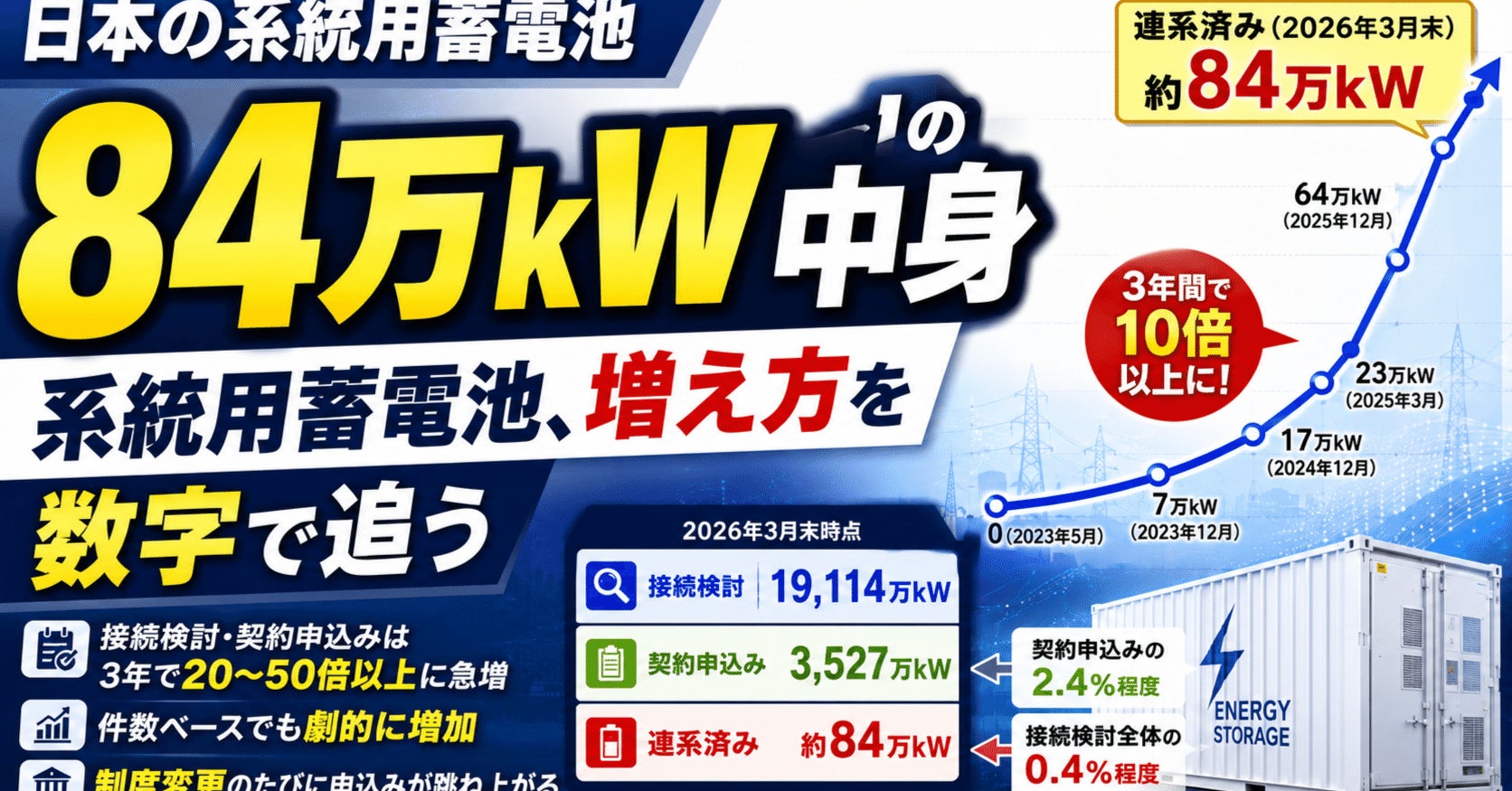
Grid battery capacity up more than tenfold in three years, webinar to outline adoption trends
Connected capacity reached about 840,000 kW at the end of March 2026, driven by rule changes and a surge in applications.