Keiyo Gas starts grid-scale storage facility in Gunma's Isesaki, entering battery business
The company has launched a 2-MW, 8-MWh grid storage plant in Isesaki, Gunma Prefecture, signaling an expansion into the electricity sector.

Keiyo Gas announced that it has begun operating a grid-scale storage plant in Isesaki, Gunma Prefecture, entering Japan's battery storage business. The plant has an output of 2 megawatts and a capacity of 8 megawatt-hours. The company has mainly operated in city gas, and the launch of this plant marks an expansion of its business into the electricity sector.
Grid storage plants are large-scale storage facilities connected to the electricity grid that help balance supply and demand. They charge during periods of low electricity demand and discharge when demand rises, filling the gap between supply and demand. As the use of renewable energy whose output fluctuates with the weather, such as solar and wind power, spreads, the importance of these balancing functions will grow.
Lithium-ion batteries and other cells are commonly used at the core of storage systems, which consist of battery units, power conversion equipment and control systems. Such plants are said to offer more flexibility in choosing sites and relatively short construction periods compared with power plants. Their fast charging and discharging make them suited to supply-and-demand balancing functions such as stabilizing frequency and voltage.
Revenue for grid storage plants is generally expected to come from profits on price differences through electricity market trading, payments for participating in balancing markets, and income from capacity markets. However, the announcement did not disclose specific revenue models or contract terms. The profitability of the business will depend on how these revenue streams are combined.
In Japan, the introduction of storage batteries is advancing across the country, driven by the move toward decarbonization. Similar projects are spreading among major utilities and emerging operators, and gas companies entering the battery storage business are seen as an example of diversification by firms that handle both electricity and city gas.
Key points to watch are the operating track record of the plant and which markets the company will use to generate revenue. Details on the scale at which the company plans to expand its battery storage business are also expected to be revealed in future announcements.
BLUE NOVA Hydrogen Journal view
The plant can be read as an example of a gas company beginning to take part in the electricity system's balancing functions, as demand grows for those who can balance supply and demand amid the expansion of renewable energy. A scale of 2 MW and 8 MWh is one example among grid storage plants. If the revenue structure and operating results become clear, it will be possible to evaluate more concretely how gas utilities approach the battery storage business. The move is notable as a sign of how existing energy companies will support the variability of renewable energy in the decarbonization drive.
Source: みんなの広報宣伝部
This article was written by the editors based on the cited report and translated from Japanese. AI is used to assist in writing and translation.
More news

RIKEN VITAMIN and Puchipuchi co-develop masterbatch made from recycled raw materials
The masterbatch, which uses recycled raw materials, has been used in some Puchipuchi bubble cushioning products since April 2026.

Yamaguchi seminar on logistics efficiency and decarbonization set for Nov. 18 in Shimonoseki
The seminar, following full enforcement of the revised Logistics Efficiency Act, covers modal shift and joint transport.

Socotec gives reasonable assurance for CFP of Asahi Kasei's Korean unit's acrylonitrile
Socotec has provided reasonable-level assurance for the fiscal 2025 product CFP of acrylonitrile made by Tongsuh Petrochemical.
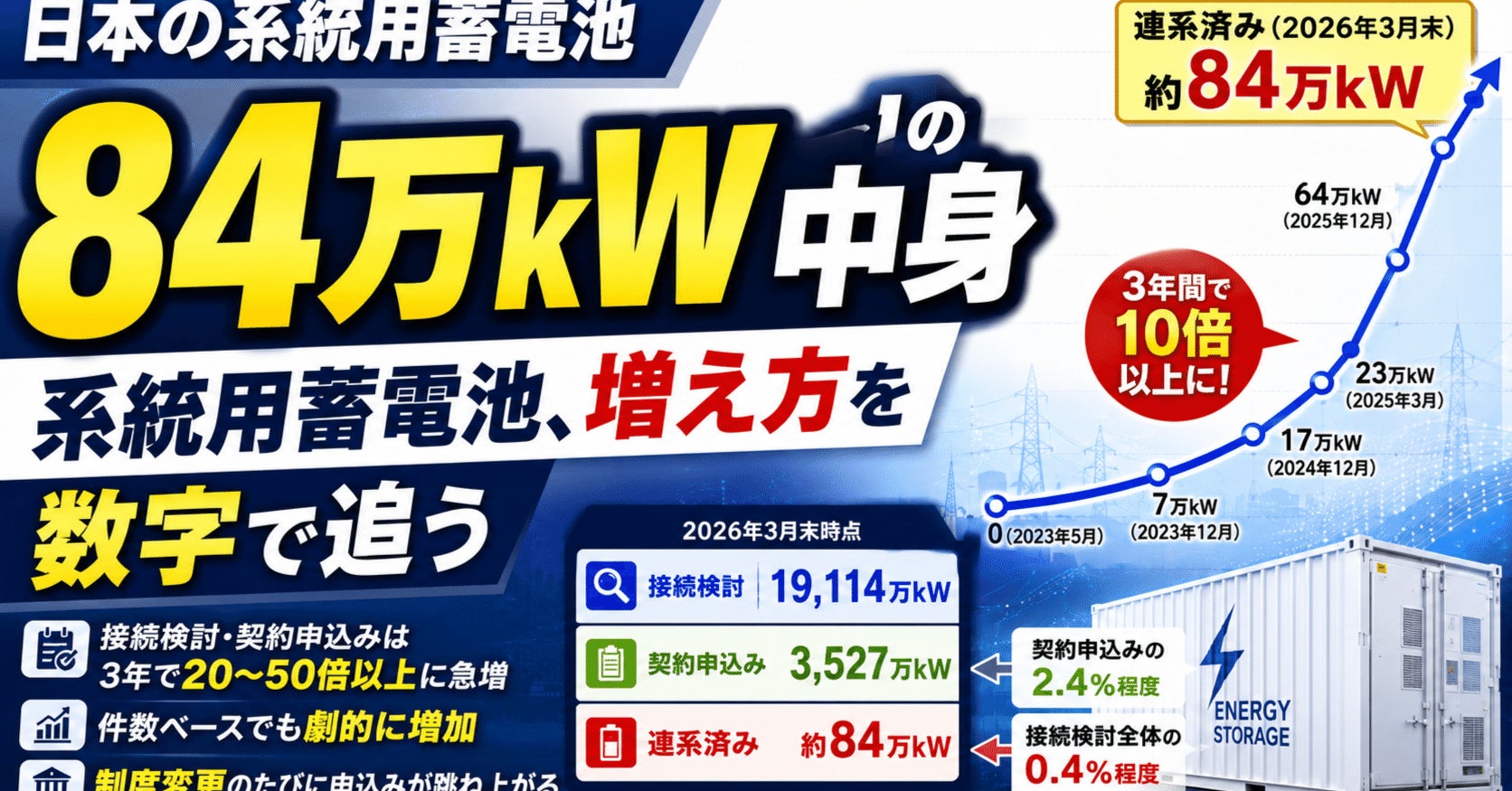
Grid battery capacity up more than tenfold in three years, webinar to outline adoption trends
Connected capacity reached about 840,000 kW at the end of March 2026, driven by rule changes and a surge in applications.