Q.ENEST Holdings Enters Balancing Market with Its First Grid-Scale Battery Storage Plant
The company said it has entered the balancing market, which keeps electricity supply and demand in equilibrium, using a grid-connected battery storage plant.

Q.ENEST Holdings said it has entered the electricity balancing market by using a grid-scale battery storage plant, its first such facility. The plan involves adjusting output in response to fluctuations in supply and demand using storage equipment connected to the grid.
The company is a group engaged in power generation and storage businesses related to renewable energy. With this entry, it expands its role beyond power generation to include serving as a power source that contributes to grid stability.
The balancing market is where transmission and distribution operators procure adjustment capacity to quickly close gaps between electricity supply and demand. Its main purpose is to keep the grid frequency constant, and transactions are completed when generators and batteries respond.
A storage plant stores electricity and can discharge it when needed. It absorbs surplus power during periods when generation exceeds demand and supplies it during periods of shortage, and it is attracting attention as a way to smooth output fluctuations from renewable energy.
In Japan, the balancing market opened in 2021, and the range of power sources that can respond to frequency adjustment has been expanding. Because batteries respond quickly, they are positioned as easy-to-use power sources in such markets.
Revenue from a storage plant is mainly made up of compensation for adjustment capacity traded in the market. It also earns profits from electricity trading. Costs center on the battery itself, grid connection work, and maintenance, and recovering the initial investment requires an accumulated track record of operation.
The key point to watch is how the company will change its trading volume and revenue structure in the market through operation of its storage plants. The scale at which the company will expand its storage plants in the future is also a focus.
BLUE NOVA Hydrogen Journal view
Entry by a grid-scale storage plant into the balancing market shows that systems supporting grid stability are moving into practical use as renewable energy spreads. Batteries absorb fluctuations in power generation and create supply headroom, so demand is expected to rise alongside the expansion of solar and wind power. This entry is one example of a power producer combining storage to achieve both revenue and grid contribution. Actual trading results and plant operating status will likely serve as reference points for similar operators.
Source: Dellows News
This article was written by the editors based on the cited report and translated from Japanese. AI is used to assist in writing and translation.
More news

RIKEN VITAMIN and Puchipuchi co-develop masterbatch made from recycled raw materials
The masterbatch, which uses recycled raw materials, has been used in some Puchipuchi bubble cushioning products since April 2026.

Yamaguchi seminar on logistics efficiency and decarbonization set for Nov. 18 in Shimonoseki
The seminar, following full enforcement of the revised Logistics Efficiency Act, covers modal shift and joint transport.

Socotec gives reasonable assurance for CFP of Asahi Kasei's Korean unit's acrylonitrile
Socotec has provided reasonable-level assurance for the fiscal 2025 product CFP of acrylonitrile made by Tongsuh Petrochemical.
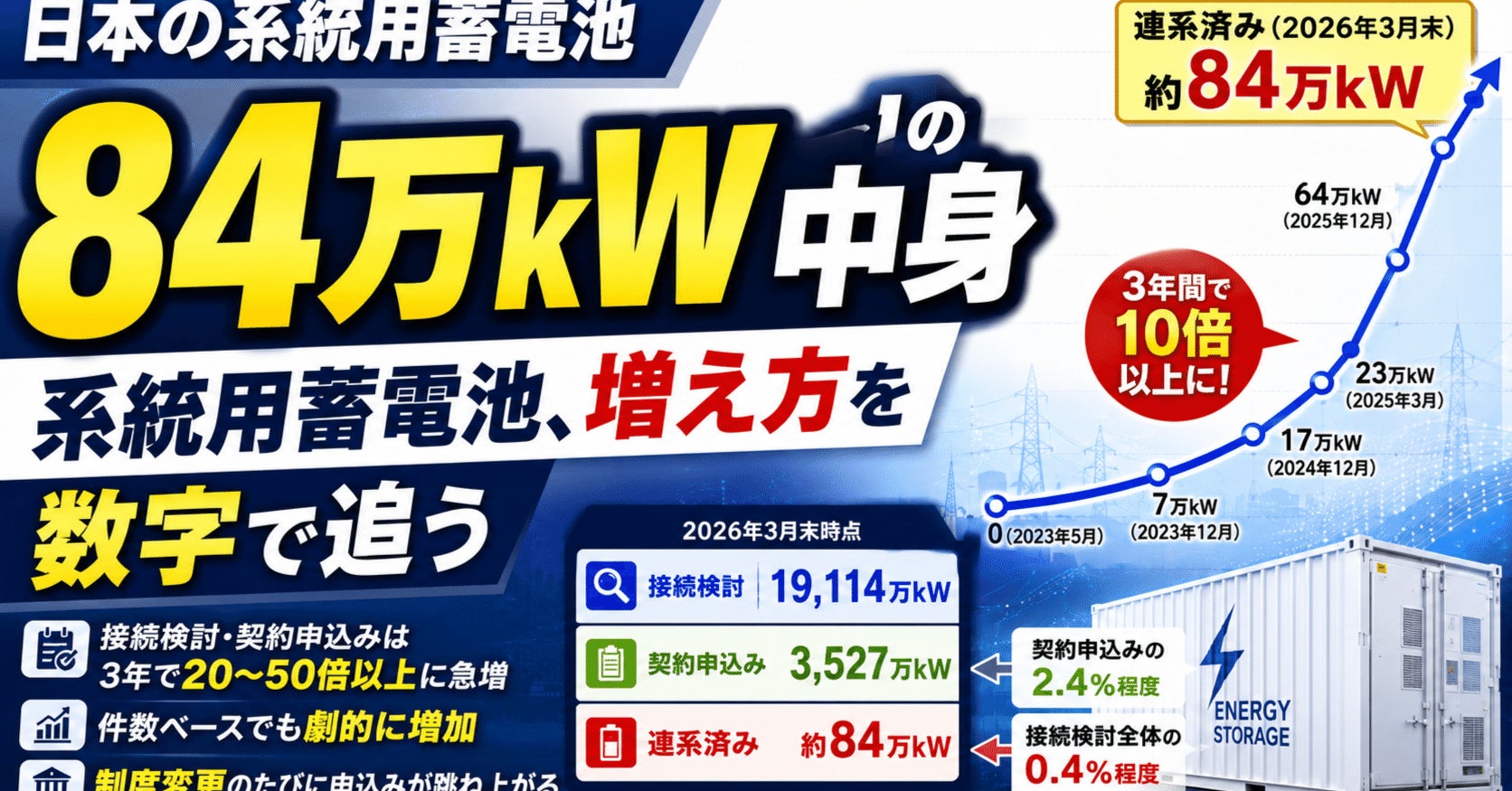
Grid battery capacity up more than tenfold in three years, webinar to outline adoption trends
Connected capacity reached about 840,000 kW at the end of March 2026, driven by rule changes and a surge in applications.