Panasonic moves up mass production of power-generating windows to 2029 as commercialization accelerates
Panasonic announced it will bring forward mass production of perovskite solar power-generating windows ahead of its previous plan.

Panasonic announced that it will bring forward mass production of power-generating windows using perovskite solar cells to 2029. The company plans to bring the product to market earlier than originally planned, bringing the practical use of next-generation solar cells closer.
Power-generating windows use the window glass of buildings themselves to generate electricity. Their feature is that they can capture sunlight without relying on installation space such as roofs or walls, and because windows are easier to secure sufficient surface area in urban high-rise buildings, they are expected to become a new source of power generation.
Perovskite solar cells are next-generation solar cells that can be made thin and light. Research has focused on applications in places that were difficult for conventional solar cells, such as building walls and windows.
Conventional solar panels have mainly been crystalline types using silicon. In contrast, perovskite can be formed as a thin film, which is said to enable material savings in manufacturing and processing into flexible shapes. However, durability and quality assurance during mass production are challenges, and establishing mass production technology is essential for practical use.
From the perspective of decarbonization, the significance lies in the ability to increase renewable energy without securing large new plots of land, if existing windows and exterior walls of buildings can be used for power generation. It is also drawing attention as a means of generating power in urban areas, which helps promote local production and consumption of electricity.
Going forward, attention will focus on progress in mass production and product details. The direction of development competition among companies on perovskite solar cells will also be a factor determining the speed of adoption.
BLUE NOVA Hydrogen Journal view
The bringing forward of mass production for power-generating windows can be seen as a move to extend solar power installation sites to building windows. Power generation that does not depend on roofs or land can contribute to both urban decarbonization and the expansion of renewable energy. The key point of this news is that the thin and light nature of perovskite opens up applications that were difficult with existing panels. With the timeline for practical use moving forward concretely, it may also prompt building material makers and electricity companies to revise their introduction plans. The next focus is the stage of verifying mass production quality and durability.
Source: XenoSpectrum
This article was written by the editors based on the cited report and translated from Japanese. AI is used to assist in writing and translation.
More news
RIKEN VITAMIN and Puchipuchi co-develop masterbatch made from recycled raw materials
The masterbatch, which uses recycled raw materials, has been used in some Puchipuchi bubble cushioning products since April 2026.

Yamaguchi seminar on logistics efficiency and decarbonization set for Nov. 18 in Shimonoseki
The seminar, following full enforcement of the revised Logistics Efficiency Act, covers modal shift and joint transport.

Socotec gives reasonable assurance for CFP of Asahi Kasei's Korean unit's acrylonitrile
Socotec has provided reasonable-level assurance for the fiscal 2025 product CFP of acrylonitrile made by Tongsuh Petrochemical.
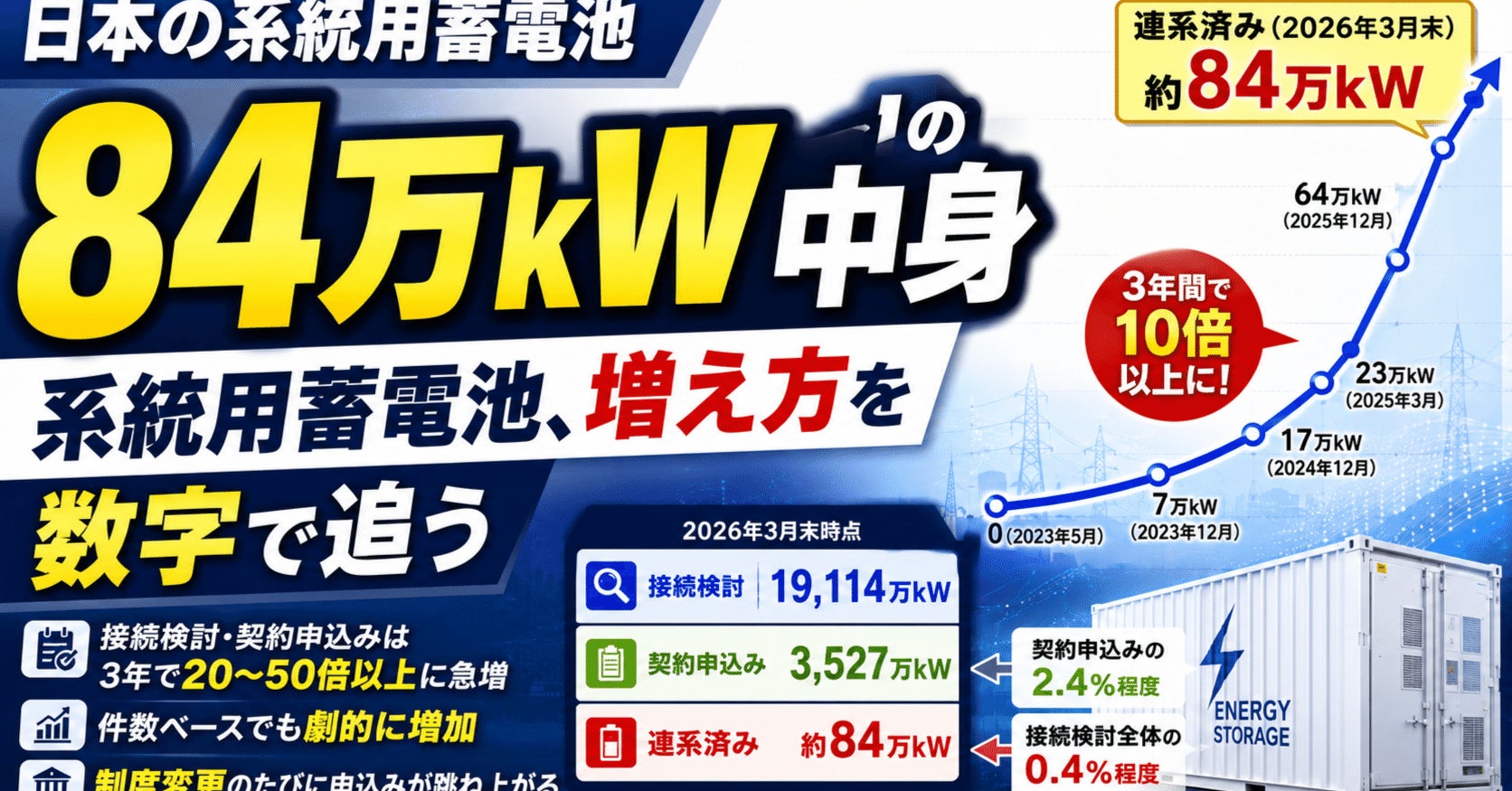
Grid battery capacity up more than tenfold in three years, webinar to outline adoption trends
Connected capacity reached about 840,000 kW at the end of March 2026, driven by rule changes and a surge in applications.