NEDO sets perovskite solar training courses led by University of Tokyo through FY2029
NEDO has finalized the structure for the program, which the University of Tokyo and others will run through fiscal 2029 to train next-generation solar cell engineers.

The New Energy and Industrial Technology Development Organization, NEDO, said it has decided on the structure for implementing training courses on perovskite solar cells. The University of Tokyo and others will take the lead in running the courses through fiscal 2029.
NEDO is a national research and development agency that supports research and development in energy and industrial technology. The courses aim to train people who will lead research and development on perovskite solar cells, which are drawing attention as a next-generation solar technology.
Perovskite solar cells use a material with a crystal structure called perovskite in their power-generating layer. They can be made thin and light and are easy to install on curved surfaces and building walls, and they are expected to find uses different from those of existing silicon-based solar cells.
Challenges remain for practical use, including the durability of materials and establishing manufacturing processes. Engineers are needed in both research and industry, and a system in which universities and companies work together to train people is required.
Deciding on this implementation structure can be seen as putting in place a framework to continue training people within the national research and development program. With universities running the courses, the supply of people who can bridge basic research findings to industry is expected.
Attention will focus on how course participants become active at research institutions and in industry. Whether perovskite solar cells can be put into widespread use will also depend on the depth of such talent.
BLUE NOVA Hydrogen Journal view
Perovskite solar cells are highly anticipated for their light weight and thinness, which allow installation in places where conventional panels cannot go. However, substantial challenges remain in mass production and durability as the technology moves from research to industry. The training courses aim to develop people who understand materials, cell devices and manufacturing technology together. Having the University of Tokyo and other research institutions lead the courses should help secure people who can bridge academia and industry. From the perspective of strengthening Japan's domestic solar technology, the long-term effort is worth watching.
Source: みんなの広報宣伝部
This article was written by the editors based on the cited report and translated from Japanese. AI is used to assist in writing and translation.
More news

RIKEN VITAMIN and Puchipuchi co-develop masterbatch made from recycled raw materials
The masterbatch, which uses recycled raw materials, has been used in some Puchipuchi bubble cushioning products since April 2026.

Yamaguchi seminar on logistics efficiency and decarbonization set for Nov. 18 in Shimonoseki
The seminar, following full enforcement of the revised Logistics Efficiency Act, covers modal shift and joint transport.

Socotec gives reasonable assurance for CFP of Asahi Kasei's Korean unit's acrylonitrile
Socotec has provided reasonable-level assurance for the fiscal 2025 product CFP of acrylonitrile made by Tongsuh Petrochemical.
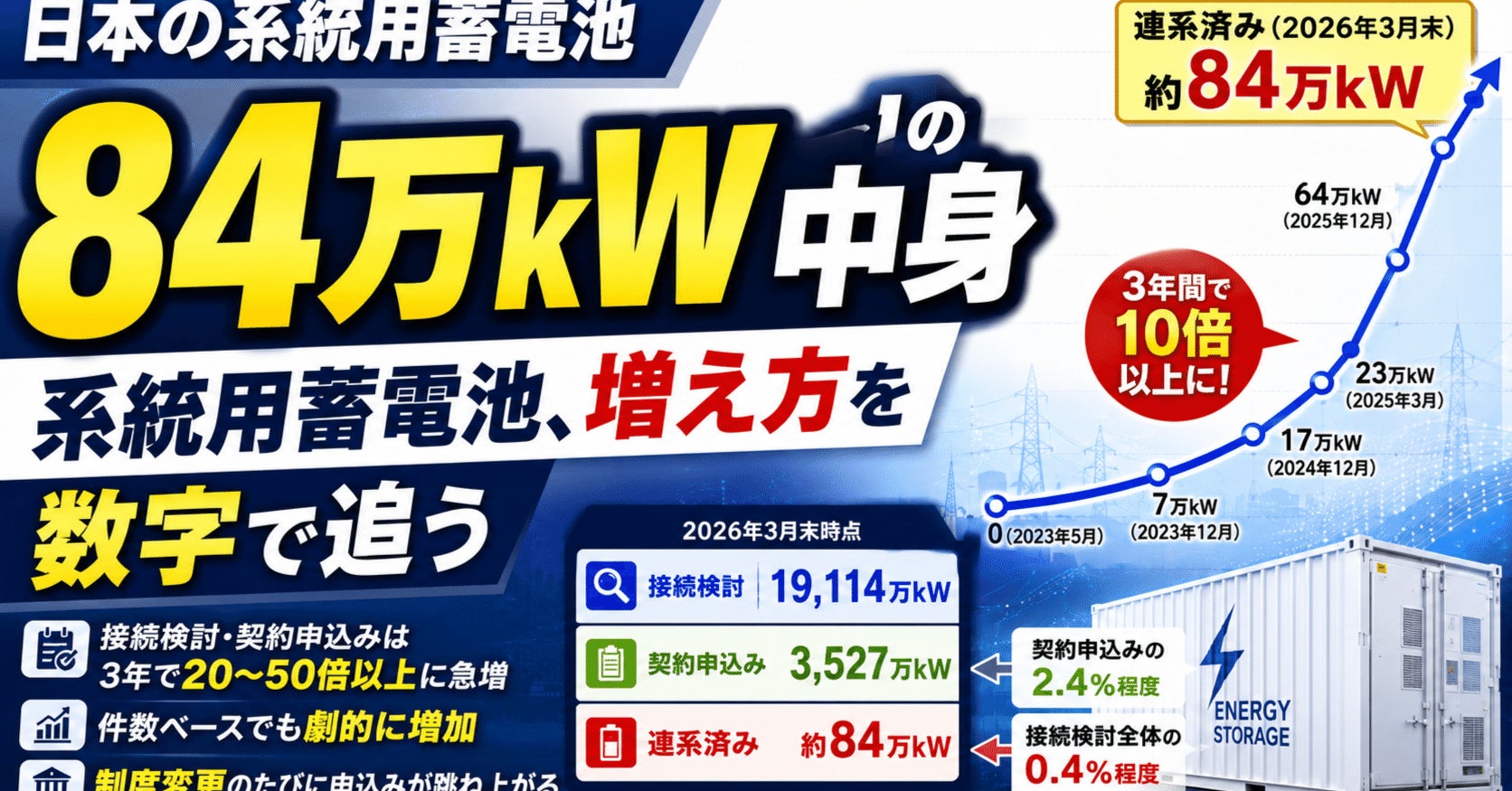
Grid battery capacity up more than tenfold in three years, webinar to outline adoption trends
Connected capacity reached about 840,000 kW at the end of March 2026, driven by rule changes and a surge in applications.